

Feathered Friends
New Jersey is home to a large variety of bird-life, making it one of the best states in the country for birdwatching. Our diverse habitats and location in the the Atlantic Flyway (a migratory route along the Eastern Seaboard) makes our home state a great place for feathered friends to visit.
The Center for Hope, nestled right on the border of the Ash Brook Reservation (667 acres of scenic beauty, diverse wildlife, and over 5 miles of hiking trails), makes a perfect stop for birds to say hello to our residents!
We've installed a smart-camera bird feeder in our yard, accessible in every patient suite on our bedside connected iPads. For info on how to view them remotely, email info@cfhh.org.
Thanks to a volunteer from The Raptor Trust (a Millington, NJ based nonprofit dedicated to the care and rehabilitation of wild birds), we have identified some of the common visitors to our facility.
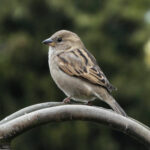
House Sparrow. The house sparrow is native to most of Europe, the Mediterranean Basin, and a large part of Asia. Its intentional or accidental introductions to many regions, including parts of Australasia, Africa, and the Americas (brought here in 1851), make it the most widely distributed wild bird. Learn more here.

Common Grackle. The common grackle is a species found in large numbers through much of North America. First described in 1758, the common grackle has three subspecies. Adult common grackles have a long and dark bill, pale yellow eyes, a long tail, and often a bluish iridescent appearance on their head, especially males. Common grackles can be found widely across North America east of the Rocky Mountains. Learn more here.

Northern Mockingbird. A mockingbird commonly found in North America; the species is also found in some parts of the Caribbean, as well as on the Hawaiian Islands. The species is known for its ability to mimic bird calls and other types of sound, including artificial and electronic noises. Studies have shown its ability to identify individual humans and treat them differently based on learned threat assessments. Learn more here.

Mourning Dove. It is one of the most abundant and widespread North American birds and a popular gamebird, with more than 20 million birds (up to 70 million in some years) shot annually in the U.S., both for sport and meat (yet, maintains its population due to prolific breeding). The wings make an unusual whistling sound upon take-off and landing, a form of sonation. The bird is a strong flier, capable of speeds up to 55 mph. Learn more here.

Cardinal. It can be found in southeastern Canada, through the eastern United States from Maine to Minnesota to Texas, New Mexico, southern Arizona, southern California and south through Mexico, Belize, and Guatemala. It is also an introduced species in a few locations such as Bermuda and Hawaii. It was once prized as a pet, but its sale was banned in the United States by the Migratory Bird Treaty Act of 1918. Learn more here.

Cedar Waxwing. Native to North and Central America, it winters in the southern half of the United States, Central America, and the far northwest of South America. It is a medium-sized bird that is mainly brown, gray, and yellow. Some of the wing feathers have red tips, the resemblance of which to sealing wax gives these birds their common name. Learn more here.

Red Bellied Woodpecker. These birds mainly search out arthropods on tree trunks. They may also catch insects in flight. They are omnivores, eating insects, fruits, nuts and seeds. In some parts of their range, they will also consume the eggs of box-nesting Wood ducks. They can stick their tongues out 2 inches past the end of their beak. Learn more here.

Downy Woodpecker. The downy woodpecker is a species of woodpecker, the smallest in North America. Length ranges from 14 to 18 cm (5.5 to 7.1 in). Downy woodpeckers primarily live in forested areas throughout the United States and Canada, with the exception of deserts in the southwest and the northern tundra. The bird nests in tree cavities and feeds primarily on insects, although it supplements its diet with seeds and berries. Learn more here.

Blue-gray Gnatcatcher. Blue-gray gnatcatchers prefer humid areas with large leaves, woodlands, and more open sandy areas with sparse trees where they mainly eat insects, insect eggs, and spiders. The males often work to build nests, help incubate and raise the young, as well as feed the children, often thought to be a mother's role. Learn more here.

American Robin. The American robin is the most abundant landbird in North America, with an estimated 370 million individuals. The species is active mostly during the day and assembles in large flocks at night. Its diet consists of invertebrates (such as beetle grubs, earthworms, and caterpillars), fruits, and berries. The adult's main predator is the domestic cat; other predators include hawks and snakes. Learn more here.

Red-Winged Blackbird. The Red-winged Blackbird is one of the most abundant living land brid in North America. It also ranks among the best-studied wild bird species in the world. The red-winged blackbird male is all black with a red shoulder and yellow wing bar, while the female is a nondescript dark brown. Seeds and insects make up the bulk of the red-winged blackbird's diet. Learn more here.

Chimney Swift. Like all swifts, it is incapable of perching on flat surfaces, and can only perch on vertical surfaces. Many fly around all day and only come down at night when roosting. The chimney swift feeds primarily on flying insects, but also on airborne spiders. It generally mates for life. It builds a bracket nest of twigs and saliva stuck to a vertical surface, which is almost always a human-built structure, typically a chimney. Learn more here.

Blue Jay. The blue jay feeds mainly on seeds and nuts, such as acorns, which it may hide to eat later; soft fruits; arthropods; and occasionally small vertebrates. It typically gleans food from trees, shrubs, and the ground, and sometimes hawks insects from the air. Blue jays can be very aggressive to other birds; they sometimes raid nests and have even been found to have decapitated other birds. Learn more here.

Songbird. Species of songbirds are found all over the world, in which the vocal organ typically is developed in such a way as to produce a diverse and elaborate bird song. The song in this clade is essentially territorial, but also for mating purposes. Selection among songbirds is highly based on mimetic vocalization. Female preference has shown in some populations to be based on the extent of a male's song repertoire. The larger a male's repertoire, the more females a male individual attracts. Learn more here.

Hummingbird. Hummingbirds are known by that name because of the humming sound created by their beating wings, which flap at high frequencies audible to other birds and humans. They have varied specialized characteristics to enable rapid, maneuverable flight: exceptional metabolic capacity, adaptations to high altitude, sensitive visual and communication abilities, and long-distance migration in some species. Among all birds, male hummingbirds have the widest diversity of plumage color. Hummingbirds are the smallest mature birds. Learn more here.